• 0 Posts
  • 17 Comments
Joined 1 year ago
cake
Cake day: July 7th, 2025

help-circle

  • Because installing Steam (which bundles proton) is soooo inconvenient…

    Steam is fine, but there are obscure edge cases in which it won’t help. For example, I have one of the game launchers (running as AppImage) which, when I press Play, invokes Wine to actually run the game. On most immutable distros, this will be a problem, because it looks for Wine as a system package, it’s not in the .iso, and getting it redirected to Wine as a Flatpak is a PITA, while using rpm-ostree has issues of its own. Bazzite has Wine built in, and so this problem simply doesn’t arise.

    This absolutely is an edge case most gamers won’t face, but consistency is a big deal. Also, as a sidenote, I was pleased by Bazzite having a driver for my obscure 20-year-old printer built in, otherwise it would require me to use rpm-ostree to install it, and it’s again far from optimal.

    Which distros and games are you comparing

    CachyOS vs Bazzite, Cyperpunk 2077, World of Warcraft, Minecraft, Space Engineers. Of course, this is a little bit of apples vs bananas, but you get the point. If you want a more correctly performed test, The Linux Experiment recently compared CachyOS to regular Arch in several games:

    https://tilvids.com/w/kuTYMmJUmg54F6rN6Gj2j8

    Gamers Nexus made a good video on Linux benchmarks if you feel like learning.

    I’ll look into it.


  • Yes in the sense that you can play all the same games on any “non-gaming” distro.

    No in the sense of convenience, optimization, out-of-the-box features etc. Speaking of two distros presented here, CachyOS is greatly optimized and truly does increase your FPS compared to other distros (and by quite a lot, like 10-15% on average from what I’ve experienced!), while Bazzite has all the Wine/Proton stuff baked into the system, which saves a lot of trouble in some edge cases where Bottles or similar software won’t help, and ensures proper graphics driver operation, especially on older Nvidia cards, which is another annoyance on stock Fedora.

    Can you do all of this manually? Technically, yes. But then why not go straight LFS if DIY approach is a priority? Gaming distros bundle all you need to play without extra bother.


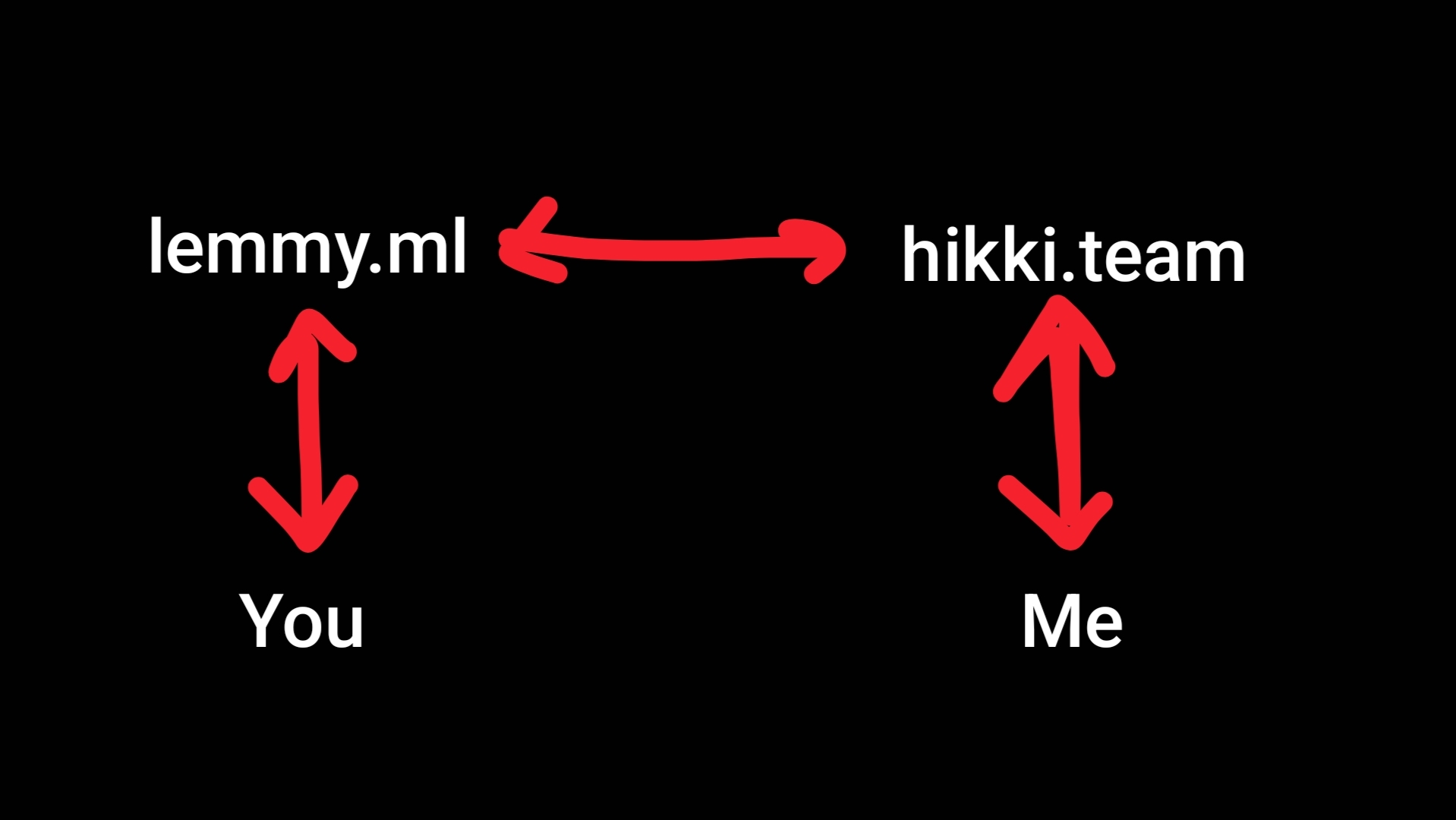
  • An instance effectively is the website. Just a more techy term. Lemmy.ml is your instance and hikki.team is mine. You write something on your site (lemmy.ml), I get it on mine (hikki.team), and vice versa. This is possible because our two sites interact between themselves (i.e. “federate”).

    The overall process is like this:

    • I wrote this reply and hit “send”.
    • My browser (well, in my case, a Lemmy app, specifically Eternity) has sent it to hikki.team, the site I chose to connect to Lemmy from (i.e. my instance).
    • hikki.team has sent it to lemmy.ml (and to all the other instances, too)
    • lemmy.ml figured from the data it received that it’s a reply to your comment
    • Since your account is registered on lemmy.ml, it sent you a notification, so you wouldn’t miss it among all the rest. Ping!

    Now, if you decide to reply to me, it will go that same way in reverse.

    Here’s a quick doodle: 2938

    From a user perspective, the interaction within an instance or between them doesn’t differ at all, and that’s the whole point. No matter where you enter Lemmy, you connect to all of it. You see my reply regardless.

    It’s not just Lemmy, either. People coming to PieFed/Kbin/Mbin can also see this post, the comments, and reply to them. The software they use affects their user experience, but doesn’t change their ability to connect with others. That’s one of the key promises of Fediverse - ideally, all Fediverse instances (websites) running any Fediverse software should interact in this way, forming a single network that everyone interacts with in their own way.


  • I think that, eventually, we’ll have to resort to networks of trust. Meeting each other offline and confirming this person does indeed exist is one way of severely reducing the influx of bots.

    The problem is, it takes a much bigger effort and makes building global networks and new registrations much, much harder. It’ll take a while for the same person to be confirmed in the US and then confirm someone in, say, Philippines.