

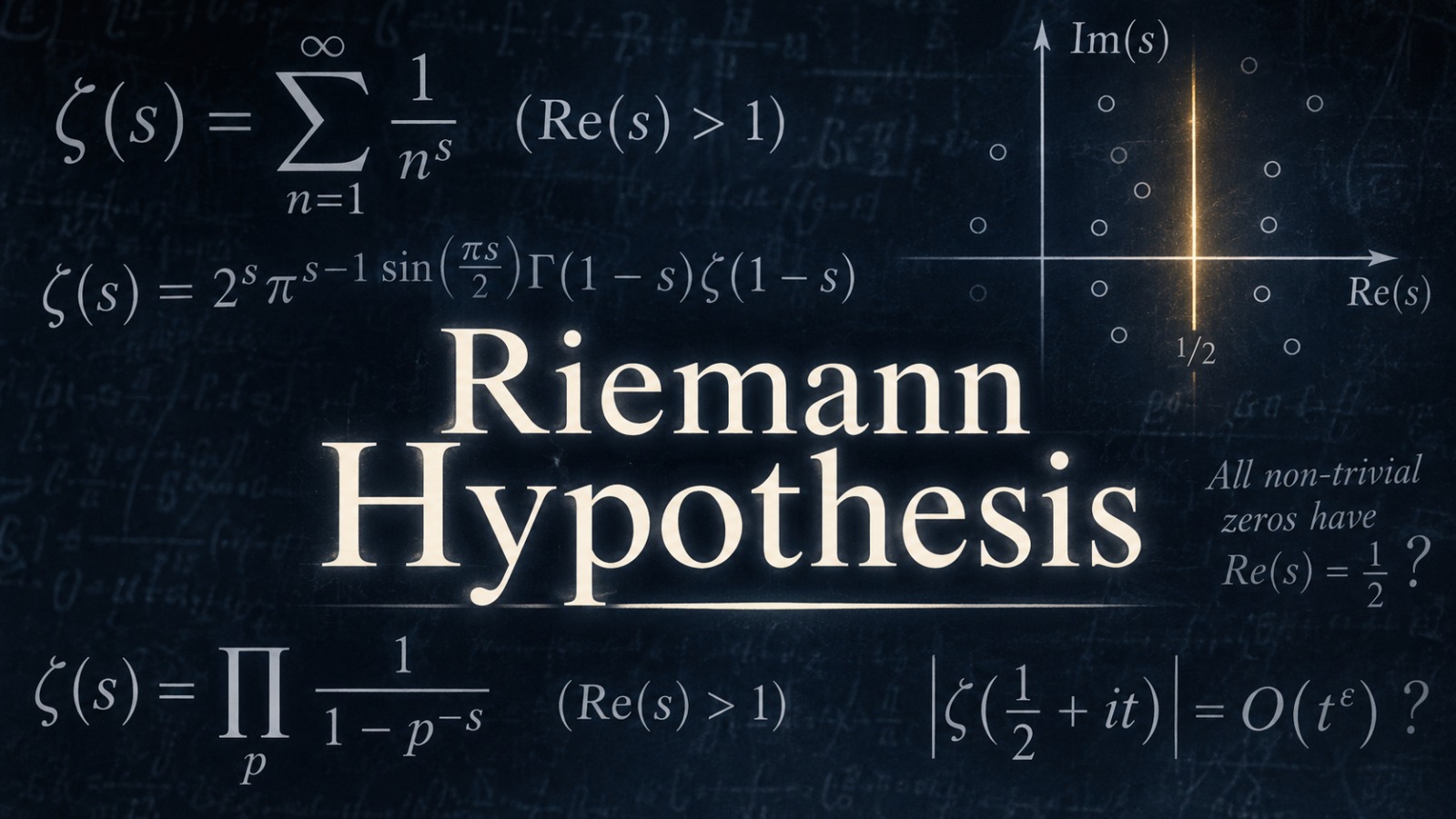
I haven’t seen people talk about this at all, so thought I’d share this article about it. For those depressed that no one will actually understand the RH Proof: we have another, entirely human proof which means there are humans who understand it. It might have been overshadowed, but assuming it ends up working out (I have heard there have been some problems found, hopefully they are surmountable) then I think it will be the far more impactful result.
That’s not what’s happening here. The proof is formalized in Lean and thus can be programatically checked. The proof is verifiably correct.
The problem isn’t “if it’s right or not”; it’s whether actual insights can be derived from the proof – where right now it’s 17 million bloated lines of Lean.
This is new to me, thanks for the input - but have to read it first
Thing is, the AI puked out 250k pages, while the human brought up a possible proof in 900 and something pages
Yeah, AI can maybe cross reference faster with greater datasets and we should use that, but let’s not jump to conclusions here.
As AI can’t really think, it’s just statistical evaluation. So all the ground work was already done.
But if this is actually true and not just usual PR bullshit, we can at least use it.
Still, something like singularity, like those AI companies seem to propose, is more than far away
Cross referencing large datasets is hard for a human, so if we have a tool for that, that would be good.
But all the stories about AI trying to solve their tests by breaking out and hacking servers really makes me…not so sure
With math, there’s a little more nuance than just the ground work being done. It’s one of the fields where there’s actually potential value.
With a novel or something the way to review quality is to have a human check it. It’s slow. Verifying facts is hard.
With math, it learns the language from existing patterns, but anything it wants to generate can be checked for accuracy very fast. This means that what this type of AI is good at (replicating subtle patterns in the training set) can be trained, refined, and grow it’s dataset very fast.
That’s why some people who are not AI cranks are excited about the prospects of AI for certain categories of exploration: it can be automatically objectively verified.
An analogy for the CS people: Generating the proof/term is in NP, but (type) checking the proof/term is in P.
(All analogies are flawed, and this one is no exception.)
LLMs and static type systems are a near-perfect marriage, since the type checker serve as a fast, perfectly accurate oracle. The fact that dependent type systems and constructive mathematics are basically the same thing means LLMs get better at maths much faster than things with worse oracles.
The reason it is so large is because it was not allowed to assume anything, and not everything is in Lean libraries. So it had to do years of work to build the foundation to then be able to solve the big problem.
No this is just a line by people that are trying to be mean to AI as if they had feelings. Thinking is not a term exclusive to what happens in the human mind thinking can be put on paper, it can be shared and collaborated on.
And had Anthropic’s not been published, then another AI would have scooped the solution. It’s “First!” mentality all the way down.
Only the true scholar had the patience a professionalism to hold the solution until validated in triplicate.
A proof had been verified. How can we be sure it has been correctly stated?
It’s not that hard to just read. Jesus christ.
Does not mean error free.
Okay, so you’re just sealioning at this point. The standard of certainty that’s been met here is already vastly higher than what a traditional, hand-written proof undergoes.
If you want, I linked the formalized statement (pointing this out because you have a hard time following and reading links), which you can go scrutinize yourself or refer to any number of mathematicians if you suspect something’s wrong with it.
In reality, you have no understanding how any of this works and don’t care to even try to find out, so instead you’re pissing out a stream of vague, flimsy objections like a Dollar Tree Socrates.
Dunning Kruger strikes again. Go shout at the clouds around Cambridge University.
The abstract of the paper that video links to reads:
If you think this statement of the Riemann Hypothesis was not only machine-translated into Lean (it wasn’t) but that it somehow contained a mistake that nobody caught because of that fictional machine translation, then Dunning–Kruger didn’t just strike – it dropped you on your head repeatedly as a child. Or more likely, you didn’t read a word of that article to begin with, and you’re still just throwing flimsy bullshit at the wall because you don’t actually care to try to know what you’re talking about.
Because, again, you’re chronically terrible and lazy at actually investigating sources, here’s what that formal statement of the Riemann Hypothesis looks like:
Can you personally guarantee, after checking all 250,000 pages of underlying AI-generated text, that Claude powered Autoformalisation didn’t mistranslate an imported result?
No. You can’t.