

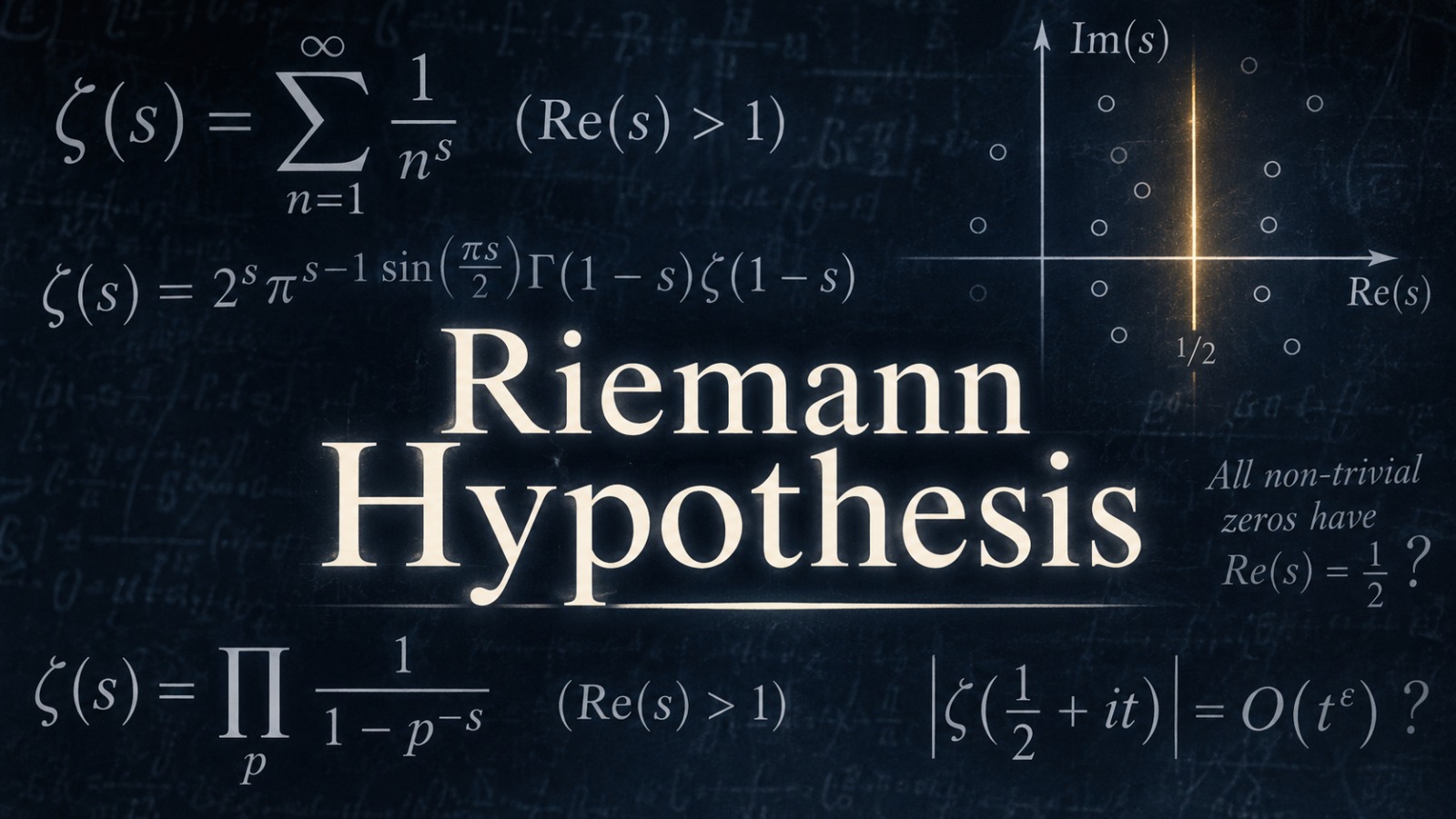
I haven’t seen people talk about this at all, so thought I’d share this article about it. For those depressed that no one will actually understand the RH Proof: we have another, entirely human proof which means there are humans who understand it. It might have been overshadowed, but assuming it ends up working out (I have heard there have been some problems found, hopefully they are surmountable) then I think it will be the far more impactful result.
So if I get this right, the human proof was in the process of being finalized and checked when the AI one was released which forced their hand and made them release it early and not completely finalized.
It also says that the AI solution can’t be read by humans while the Human one can. I’m no matemathician but a solution that cannot be understood by humans seems a bit limited. How do you check it? I guess you can check it empirically but that seems a bit primitive. How do you teach it to future mathematics students? Mathematics relies on building and developing previous work done by people in the field. This means studying and understanding that work and refining it or using it for new work. You can’t do that with something you don’t understand.
Math is oddly not new to proofs that no human can understand.
Godels incompleteness theorum relies on showing how to construct a proof in the form of preposterous number arrangements. The proofs themselves never got written, and even if they had they would be unintelligible.
In this case, you would demonstrate that the intermediate language has a correspondence to mathematical logic. Similar to how Godel showed how prime numbers can be arranged in such a fashion.
Godels is more useful and interesting though, because in his case the proof-of-proof was more interesting than the actual proof would have been.
Everything else you say is spot on. The knowledge one way or the other isn’t actually that important: you can just assume either way if you wanted to explore in that direction. The value is the model that helps people think about the problem in a way that gives insight.
You could literally just say “assume the Riemann hypothesis” and that’s just as good.
Apparently Masullo has been working on RH for more than a decade, and spent the last year polishing his proof and getting feedback from colleagues before releasing it. He had planned to spend another year making extra sure his proof was perfect before publishing, but was forced to share an unfinished version because of this recent announcement.
Meanwhile Anthropic shits out a 17-million-line proof and says to the world “idk, you figure it out if it’s right or not”. Kinda makes me cynical about their motives here. Seems like they’re much less interested in advancing the field and much more interested in getting positive press to juice their IPO.
Every LLM code review ever. “No idea, you check it if you feel it’s necessary.”
I don’t need to double check it when I already asked it to not make any mistakes.
Sort of, the reason I heard and makes the most sense is that these proofs were more a side effect of their training. They’ve been training the models to do math, first they started with basic math but the problem set became “saturated”, ie. It could answer every question. Then they move on to advanced math and that becomes saturated so eventually you have to give a model the hardest math questions known to man which are unsolved. Eventually the AI solves them when they give it enough compute, time and reinforcement learning cycles and they’re left with these proofs.
Their motivation for releasing them probably was for a PR win and they also probably did think they would be advancing math, but that’s not why they threw hundreds of millions of dollars of compute into solving these.
That’s not what’s happening here. The proof is formalized in Lean and thus can be programatically checked. The proof is verifiably correct.
The problem isn’t “if it’s right or not”; it’s whether actual insights can be derived from the proof – where right now it’s 17 million bloated lines of Lean.
This is new to me, thanks for the input - but have to read it first
Thing is, the AI puked out 250k pages, while the human brought up a possible proof in 900 and something pages
Yeah, AI can maybe cross reference faster with greater datasets and we should use that, but let’s not jump to conclusions here.
As AI can’t really think, it’s just statistical evaluation. So all the ground work was already done.
But if this is actually true and not just usual PR bullshit, we can at least use it.
Still, something like singularity, like those AI companies seem to propose, is more than far away
Cross referencing large datasets is hard for a human, so if we have a tool for that, that would be good.
But all the stories about AI trying to solve their tests by breaking out and hacking servers really makes me…not so sure
With math, there’s a little more nuance than just the ground work being done. It’s one of the fields where there’s actually potential value.
With a novel or something the way to review quality is to have a human check it. It’s slow. Verifying facts is hard.
With math, it learns the language from existing patterns, but anything it wants to generate can be checked for accuracy very fast. This means that what this type of AI is good at (replicating subtle patterns in the training set) can be trained, refined, and grow it’s dataset very fast.
That’s why some people who are not AI cranks are excited about the prospects of AI for certain categories of exploration: it can be automatically objectively verified.
An analogy for the CS people: Generating the proof/term is in NP, but (type) checking the proof/term is in P.
(All analogies are flawed, and this one is no exception.)
LLMs and static type systems are a near-perfect marriage, since the type checker serve as a fast, perfectly accurate oracle. The fact that dependent type systems and constructive mathematics are basically the same thing means LLMs get better at maths much faster than things with worse oracles.
The reason it is so large is because it was not allowed to assume anything, and not everything is in Lean libraries. So it had to do years of work to build the foundation to then be able to solve the big problem.
No this is just a line by people that are trying to be mean to AI as if they had feelings. Thinking is not a term exclusive to what happens in the human mind thinking can be put on paper, it can be shared and collaborated on.
And had Anthropic’s not been published, then another AI would have scooped the solution. It’s “First!” mentality all the way down.
Only the true scholar had the patience a professionalism to hold the solution until validated in triplicate.
A proof had been verified. How can we be sure it has been correctly stated?
It’s not that hard to just read. Jesus christ.
Does not mean error free.
Okay, so you’re just sealioning at this point. The standard of certainty that’s been met here is already vastly higher than what a traditional, hand-written proof undergoes.
If you want, I linked the formalized statement (pointing this out because you have a hard time following and reading links), which you can go scrutinize yourself or refer to any number of mathematicians if you suspect something’s wrong with it.
In reality, you have no understanding how any of this works and don’t care to even try to find out, so instead you’re pissing out a stream of vague, flimsy objections like a Dollar Tree Socrates.
Dunning Kruger strikes again. Go shout at the clouds around Cambridge University.
The abstract of the paper that video links to reads:
If you think this statement of the Riemann Hypothesis was not only machine-translated into Lean (it wasn’t) but that it somehow contained a mistake that nobody caught because of that fictional machine translation, then Dunning–Kruger didn’t just strike – it dropped you on your head repeatedly as a child. Or more likely, you didn’t read a word of that article to begin with, and you’re still just throwing flimsy bullshit at the wall because you don’t actually care to try to know what you’re talking about.
Because, again, you’re chronically terrible and lazy at actually investigating sources, here’s what that formal statement of the Riemann Hypothesis looks like:
Spot on. When Alpoge published his proof, he was gloating endlessly about how he did little work and just had the model do everything. His announcement sounded like a press release written by a 12 year old.
I’m not a mathematician, but his proof sounds absolutely useless, and yet all the press is fawning over this result rather than the one that Masullo was working on, ie. the guy who did everything the right way.
I hate this AI trend, and that a proof of a theorem is now reduced to check wether a >200k LOC program compiles is disgusting, but that a top mathematician can direct a swarm of bots to solve the holy grail of mathematics in ~2 months is incredibly news-worthy. This is moving the ground of the academic world, a lot.
I agree, but then the novelty is the capability of these statistical models. The feat on its own is not what’s novel about it.
Or to put it another way, maybe it takes some level of expertise to solve problems like this with a statistical model. Maybe even I could pull something like this off if I worked on it for a few years with infinite search tokens. But it takes a completely different level of expertise to solve it manually the way a human would. There’s a lot of people who could do it with a search algorithm - there are maybe 100 or so people in the world that could do it without one of them.
But at the end of all of this, code is still just code, whether it’s C, C++, Java, or Lean. They pretty much all work the same way. I will admit that the 2 month timeframe is impressive, but we’ve already known for a couples years by now thatLLMs can brute force their way to a solution if you give them a problem statement and an acceptance criterion…
What techniques like this can be used for in the future does sound quite incredible though.
A Lean proof is relatively easy to mechanically verify and this has been done independently already by several groups using different Lean kernels to preempt the possibility of a Lean bug. For this particular question, the existence of a proof itself is remarkable in its own right. If Masullo’s proof can be verified, it would be an even bigger deal because it can more readily translate into human digestible techniques, but until/unless it is fleshed out and accepted, it’s far less interesting. A lot of work on the Riemann Hypothesis has been done for decades, it wouldn’t be close to the first incorrect proof produced by legitimate experts.
A question I have that I don’t think I’ve seen answered anywhere. We know that the Lean project does compile and validate, across several Lean kernels. But do we know if that Lean project actually is a proof for the Riemann Hypothesis? Or could it just be validating something (even marginally) unrelated.
Let’s say I created a Lean project that verified if 1 == 1, but the actual lean code was so incomprehensibly large that no-one could understand what it was verifying, just that it did verify eventually, and said that was my Riemann Hypothesis proof. Would anyone have anything other than my word on that?
Yes, the proof is literally in the pudding.
The whole point of Lean is the strict type-checking. In effect, the proof says “this is the Riemann Hypothesis, and this is the proof” and you can be 100% certain that the proof is valid.
100 million tons of pudding; yep the proof is in there somewhere, get digging.
BTW, the proof looks exactly like pudding, good luck.
Yeah, and?
It’s still a valid proof.
Yes that’s one of the criteria that were verified by humans. In the case of the Riemann hypothesis it’s not that difficult because it’s not that complex (only proving it is difficult, spelling it out isn’t), and there was an existing human curated formalization of it too.
You can read more about it here: https://leanprover-community.github.io/blog/posts/riemann-hypothesis/
What does it take to validate Masullo’s proof though? My understanding is that it has to be examined by other experts and manually verified using existing expertise, but couldn’t it also be written in Lean as well and validated that way too?
In any case, maybe the culture around proving things in mathematics does need to change. If people doing hard research for years get sniped by people messing around with models, then maybe they need to publish more incremental progress instead of only releasing it when it’s done and thoroughly polished…
Years of time and effort from specialists. Turning it into a Lean program would help a lot but that’s not a trivial effort, it’d still take considerable time.
The culture around mathematical research is changing but not the way you’d like. Mathematicians are being more secretive about their research so that it doesn’t get sniped by a guy with a Claude subscription and published in a half-baked low quality format just to say “I did it first.”
I would not be surprised if someone got an AI to fill in the missing bits and fix the errors by making it do exactly that. Assuming the author really was on to something of course. It wouldn’t be the first human attempt to prove it that turned out to be wrong.
I knew a couple students in special needs class that genuinely wrote better shit than his announcement. So, that’s just an insult to 12 year olds to compare the two.
I hope we can all band together to make sure anthropic gets 0 of the prize money, and that it all goes to Masullo instead. Cant be held legally liable for your fuck ups? Cant get praised for ‘your sucesses’ either then.
Anthropic said they don’t intend to take the money either way
Superb, saves us the effort of creating pressure
Disagree - we still need to keep the pressure on to make sure that Masullo is recognized as the one who gets credit for it. He did the hard work can came up with the more meaningful proof, and assuming that it holds up, he should get the public recognition.
And even if it doesn’t, I don’t see any reason to publicly recognize Anthropos as the group that solved it, cause anyone could dish out 100k pages of slop to prove anything. Personally, I don’t consider that novel or noteworthy, just like all the massive slop software projects out there.
U know what fair point, i agree with you. Little bit too rushed to call off pressuring. Still good they’re not gunning for the prize but yeah i agree with u actually
Ohh, I like that. It’s very much in line with “If you can’t own it, it’s not theft. Yarghh!” I like the consistency. Fuck these Bros who want their cake and eat it, too.
Everytime AI is in the news it’s a marketing play. As simple as that. They can claim anything and it gets on all the news in all the world at the same time and everyone is talking about it. We know it says yes to anything and nobody can read that output, but whether it’s true or not doesn’t matter. Everyone has already done the advertisement for them.
It’s only a valid proof when it’s peer reviewed. The ai one isn’t
No, that is false.
You are confusing publication standards with validity.
It is a valid proof because it has been formally verified.
The AI proof is 250,000 pages. I’m curious if the math world is going to even bother trying to wade through it as that would require a team of people. I hope the academic world just writes it off.
https://github.com/leanprover-community/riemann-hypothesis/pulls
There is a large collective effort already well underway.
Why would the academic world write it off? They are extremely excited about it!
The AI solution is formalized in LEAN in such a way that it’s easy to verify by humans that it’s formalized correctly, and from there the proof as a whole can be verified by software. It’s unreadable because it’s 17 million lines of LEAN and it’s hard to get a full understanding of it, but there is now a strong consensus that it’s correct. A working LEAN proof is a much higher standard than proofs in human language are generally held to. Humans can now go through it and look for techniques that look interesting and novel and build on them. Likely there will be a shorter proof at some point in the future.
The human solution is human readable because it’s written in human language. But it’s still almost 1000 pages of text and it has to be understood by humans to verify it. By traditional standards for human work, a few mathematicians need to be convinced it’s correct and put their name on it. If we want to test it by the same standard as the AI solution then someone now has to translate 1000 pages of English into LEAN. However it was rushed out, and it’s fairly easy to see that it has holes because it literally has chapters that are empty. People are also claiming that AI agents can trivially find errors in it, but I haven’t verified those. However, human proofs of the Riemann Hypothesis that turn out to be wrong are kind of a regular thing, so I would not be surprised. If it’s salvageable though it’s still worthwhile because the human proof goes in an entirely different direction than the AI one.
Unreadable machine proofs are not a new LLM era thing by the way. The first machine generated proof that was considered unreadable wasn’t something from the last few years or even from this century, it was the one for the Robbins conjecture in 1996.
To be specific, Lean is a programming language, just one that’s specifically made for writing math proofs. If it compiles them it’s logically consistent. If part of that is an understandable version of the RH then it definitely works out. It might just take a lot of effort to understand why.
If RH being true or not is important then this is useful. If you need to understand why it’s true or not (often this is just as important, or even moreso, than the knowledge of if it’s true) then it’s less valuable.
Rational people should agree with you, but I think the Bros would say “that’s like an hostler complaining that gasoline doesn’t help his horses at all”
Except it’s more like someone giving you a car then expecting you to disassemble it then reassemble it to understand how it works using a manual written in another language.
No, its not.
I did an undergraduate in physics.
Like music, ita not just about the notes you play, but also the ones you don’t.
Why does the proof work is far more interesting than the proof. What assumptions got made, what simplifications, what symeteries were used, ect… Those details can have ramifications in other sectors. If something has to be true for the proof, and we have evidence that its true for the universe, it can imply so much more.
Its not enough to say the proof exists, its also about the path you chose to get to the proof, and what else does it say about math and the universe.
Its more like asking someone to be able to explain why every bolt is the way it is. Sure, not everyone needs to know, but someone does.
I think it’s closer to someone handing out cars for free, undercutting all competition, until nobody knows how to make cars anymore, then demanding everyone pay them their life savings for the privilege of having a WORKING car when their Ea-Nasir-level craftsmanship breaks down three days after the last mechanic shop closes.
Just wanted to answer your “how to verify” question:
The proof is written in Lean and is verified by the Lean tool chain. As long as Lean is correct as a tool, the proof can be trusted.
Understanding and using the proof or parts of it to advance math is a different undertaking.
I’m not sure I do trust Lean though. The tools I work with are getting patched for odd edge cases every day. Am I expected to suspend all disbelief and assume that there’s nothing dodgy in the 17M lines of unreadable puke that make up this proof? How confident are we that an agent wouldn’t exploit a bug in Lean to achieve its goals?
The thing is, the AI wouldn’t have to just exploit a bug in Lean.
It would have to have exploited a bug that somehow exists in multiple completely independent implementations of Lean and Lean type checkers. Either that, or the fundamental basis of formal mathematics (ZFC + universes) is wrong and if that’s true, that’s an even bigger discovery.
The Lean Prover Zulip chat is publicly accessible. You can go observe the world’s leading experts on formal mathematics work through it. They are 100% certain the proof is valid. They have moved on to reducing and simplifying the proof because it is real. They’ve even got a “why should I trust Lean?” thread open for all the tourists who have been dropping in to ask these very questions.
One part of the verification is that the proof is checked by multiple independent implementations of LEAN. A bug in the software would have to be one that has to be present in all of them to not be caught. There absolutely have been bugs before that were caught this way. But this time they seem to agree.
Calling it 17 million lines of unreadable puke is also not justified. There is a structure to it and part of the reason why it’s so much is that the AI was not allowed to introduce assumptions and went into incredible detail to prove every last little thing that went into the proof. When people make fun of things like it containing a separate proof for real numbers that are not 1/2 to be either less or greater than 1/2, realize that the alternative where the AI is allowed to just write this sort of thing down as an obvious truth like a human would means there is a list of such assumptions that have to be verified individually. So this is not a sign of slop but a tactic to make the proof easier to verify.
LLMs don’t “make assumptions”, they’re text generators, the reason it spat out 17 million lines of Lean code is because it was a brute forced random walk of the problem space.
That a human could do in 980 pages what a LLM took 250,000 pages to do, is not proof that the chatbot “went into more detail”.
Assumptions in the mathematical sense. Not talking about how LLMs operate but how the proof is structured.
The human with 980 pages has entire sections missing and errors in others. We don’t know how many more pages are needed, but we do know every single one has to be verified manually because unlike the AI he does not have anything that can be checked by a machine.
Any mathematical proof relies on the theorems and axioms that it assumes are correct. Mathematicians have proven that a proof that is formalized correctly in Lean is correct. It’s just one of the “If A then B” paths in Mathematics today. I think its a lot more likely that human mathematicians verifying Vakil’s proof would make a mistake. Although I would certainly consider Vakil’s human-readable proof far more valuable.
If there’s no bug in Lean it doesn’t matter how bad the slop is, as long as it checks out. Big if, though
Your broader sentiment about understanding and teachability are fair, but…
What? That’s the whole ballgame. It is what separate maths from other fields. Rigorous, empirical proof.
Huh? Math doesn’t rely on empirical data at all, which is the reason it isn’t considered a natural science either. If math belongs to any larger category than itself, then that would be logic, a branch of philosophy. And the empirical is entirely outside the bounds of every field of philosophy.
Ah, okay right. Fair enough. I used the term poorly here, as a matter of continuation. But maths are strictly based on logic as you mention and rigorous verification with a priori information. So yeah, poor choice on my part, but I really meant “rigorous verification” which is what I took them to mean.
Also, isn’t empiricism itself a philosophy concept? I don’t know. Any way, mea culpa.
Think it’s fair to say from context they meant that there’s a difference between a proof we can verify works correctly based on the answers it gives, versus a proof that we can also understand how and why it gives the correct answer (because sometimes the real useful stuff comes from the working out rather than the answer).
And I agree with that entirely. Just saying empirical proof isn’t primitive. That was a bit out of place it felt.
Yes, but I think they meant that only being able to empirically check it works feels primitive compared to having an additional understanding of how and why the proof works - which could lead to other new discoveries or applications that a blackbox proof simply can’t do.
I cannot verify these claims myself as I’m not a mathematician, but from what I’ve read elsewhere, but a lot of mathematics is predicated on the RH being assumed true yet unproven.
As others have mentioned, it was proven using a theorem prover called LEAN which can validate that the proof is valid, which I imagine works in the same way that a compiler processes human-written software to prove that the program that was written is valid.
I think the proof itself is probably not very useful if it’s not human readable, and while it seems like mathematicians have accepted it already, there is a small chance that it could always be invalidated if there’s a bug in the LEAN compiler or its libraries. Hopefully it can be reduced from machine-written code into something more intelligible. And maybe the techniques can be studied and incorporated into future proofs.
It’s less that it’s human readable and more that’s its just really really long and overly detailed.
It’s like saying moby dick is unreadable to a child and thus worthless.
It’s both a right and wrong point of view.
It’s not absolutely worthless, but it would be more useful if it could be understood.
For example, I could write a C program with a new and slightly different version of
printffor each time I call it. That’s a lot less useful than a general version ofprintfthat everyone can use.In this case, a proof is still a proof, but the proof itself won’t help others prove things either. That said, if these statistical models can be used to prove other longstanding problems in mathematics, then that actually does sound like something useful.
It’s basically a pointless waste of time. We only care about proofs at all because of what they tell us about the mathematical community and the intellectual interest they generate. To that end, an AI proof is basically worthless.
It’s not worthless if it convinces mathematicians that something is definitely true as opposed to being merely hypothesized and widely believed. It changes the types of questions we ask and the way we think about results that relate to RH. Something which turns out to conflict with RH is now provably false. Lines of reasoning that assume ~RH are now provably unsound. The questions about RH itself turn from “is it true” and “how do we (dis)prove it” to “what can we learn from the proof.” There’s undoubtedly still room for entire new theories to support a human-comprehensible proof, it’s just that now we have something concrete to dig through for inspiration.
Yes and no. Most mathematicians already assumed the Riemann Hypothesis was true, but regardless, mathematics isn’t about knowing a collection of facts. Do you have any idea how many brilliant students are being turned away from mathematics because of the existence of this (and other equally uninteresting) AI proofs?
Again, the value isn’t in the verification of some intrinsically inert fact, but in the intellectual prerequisites for its discovery. What is the point of a machine that spits out proofs without a community of people to interpret them? Endless machine-generated poetry in a world without poets. Machine-generated math in a world without mathematicians. Only an idiot would prefer such a mindless world.
deleted by creator
Great article, thanks 👍
strange isn’t it that both proofs have come with humans being very close at the same time
the next challenge is obviously to make clear why this machine-code-like LEAN proof is valid and useful
That’s not the next challenge at all?
Anyone with any reason or sense at all would take those AI shitbirds and tell them to go fuck themselves.
But, apparently, nobody has any fucking sense anymore, so we’re all jerking off over the things AI can do, even if it can’t really do it at all